E-Invoicing UAE: Deadlines, ASP Checks, Penalties (2026)
Need a Tax Accountant? Browse verified listings
Browse NowYour PDF invoice is no longer enough.
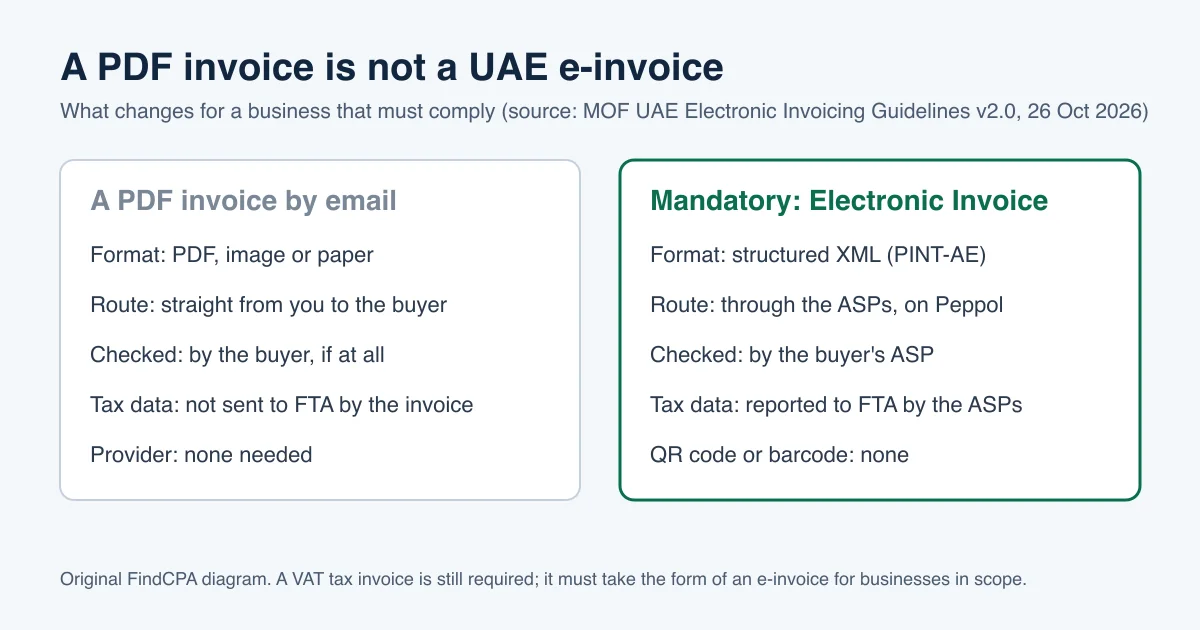
E-invoicing in the UAE is a federal system where businesses send tax invoices as structured data through an accredited provider, not as PDFs by email. The first mandatory deadline has already passed for the largest businesses, and the next one lands on 31 March 2027. This guide, updated on 22 November 2026, gives the dates, the penalties and the questions to ask before you hire help.
What Is E-Invoicing in the UAE?
The short answer is that it replaces emailed PDFs with machine-readable invoices.
E-invoicing in the UAE is a system run by the Ministry of Finance (MOF) and the Federal Tax Authority (FTA) in which businesses issue invoices as structured XML files through an Accredited Service Provider (ASP). The MOF Electronic Invoicing Guidelines, version 2.0 of 26 October 2026, apply it to every business transaction in the UAE unless excluded.
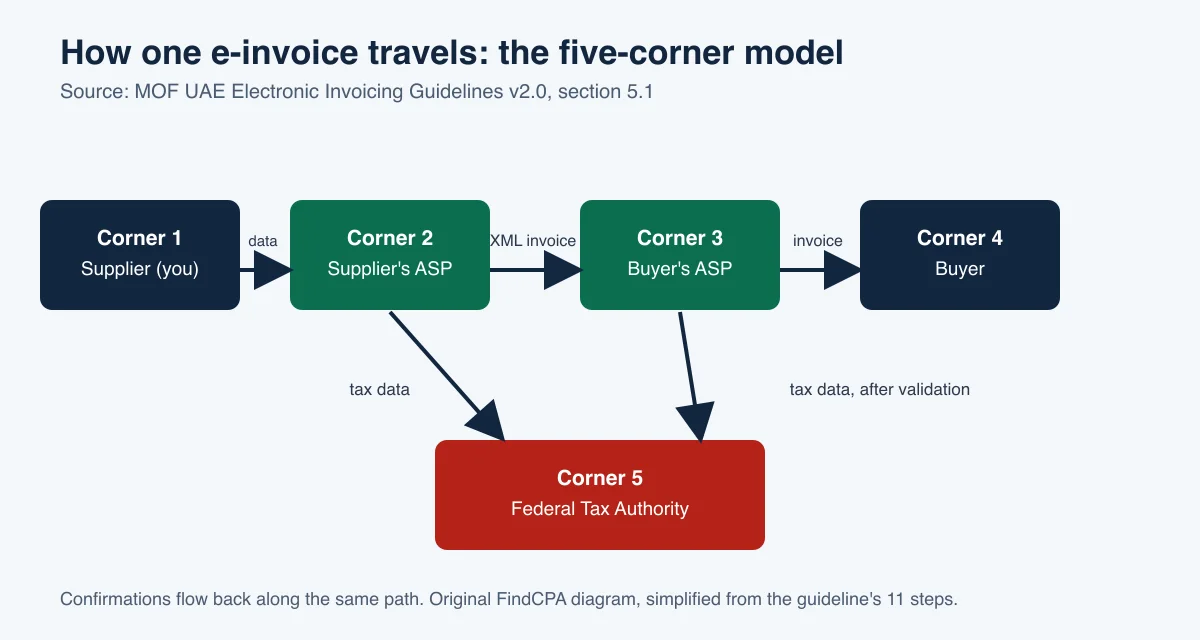
The framework is decentralised. Your ASP converts the invoice into the UAE standard format, passes it to your buyer's ASP, and reports the tax data to the FTA. Invoices follow Peppol's PINT-AE specification and carry no QR code or barcode, according to the MOF e-invoicing guidelines.
Three scope points matter for most readers:
- Business to business and government: B2B, B2G and G2B supplies are in scope.
- Consumers: supplies to individuals who are not in business are outside the scope.
- VAT registration does not decide scope: the guidelines say all persons who make a business transaction in the UAE are in scope, whatever their VAT status.
E-invoicing does not remove the VAT tax invoice. It changes its form. A business in scope must issue its tax invoice and tax credit note as an electronic invoice and electronic credit note. A buyer who is not yet onboarded may still ask for a separate PDF to support input VAT recovery.
When Is the UAE E-Invoicing Deadline for Your Business?
Your annual revenue decides your date.
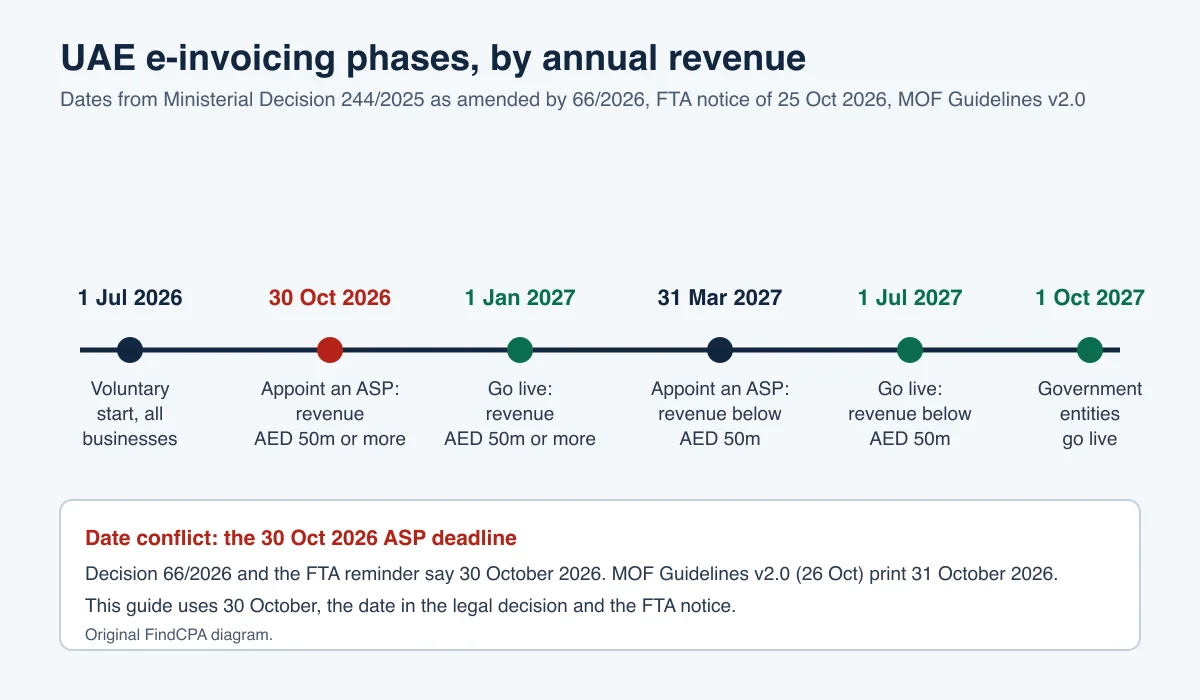
UAE e-invoicing is phased by annual revenue. Businesses with revenue of AED 50 million or more had to appoint an ASP by 30 October 2026 and must go live on 1 January 2027. Businesses below AED 50 million must appoint an ASP by 31 March 2027 and go live by 1 July 2027, per the FTA notice of 25 October 2026.
Voluntary participation has been open to all businesses since 1 July 2026. Government entities go live on 1 October 2027.
| Group | Appoint an ASP by | Go live by | Source |
|---|---|---|---|
| Revenue AED 50 million or more | 30 October 2026 (passed) | 1 January 2027 | Ministerial Decision 66/2026; FTA notice, 25 Oct 2026 |
| Revenue below AED 50 million | 31 March 2027 | 1 July 2027 | FTA notice, 25 Oct 2026; MOF Guidelines v2.0 |
| Government entities | 31 March 2027 | 1 October 2027 | MOF Guidelines v2.0 |
| Any business, voluntary | Any time | From 1 July 2026 | MOF Guidelines v2.0 |
Newly established businesses in scope must appoint an ASP and finish onboarding before they issue their first invoice, whatever their start date.
Why do the sources show two dates for the first ASP deadline?
The MOF guidelines v2.0 print 31 October 2026 as the last date for large businesses to appoint an ASP. Ministerial Decision 66/2026 says 30 October 2026, and so does the FTA reminder dated 25 October 2026.
We use 30 October. A ministerial decision is the legal text, and the FTA enforces it. If you appointed an ASP on 31 October, speak to your adviser now about your position, and do not rely on the guideline date. We cannot tell you whether the FTA would treat that day differently.
The same decision keeps the 1 January 2027 go-live date, so the conflict affects only the appointment step.
How Much Are the E-Invoicing Penalties in the UAE?
The fines are small per invoice but they stack.
Cabinet Decision 173/2026 sets e-invoicing penalties in AED: 5,000 for failing to implement the system, then 5,000 for each month or part month of continued non-compliance, capped at 50,000 within any 12 consecutive months. Issuing no e-invoice costs AED 100 per invoice, up to AED 5,000 a month.
The decision replaces Cabinet Decision 106/2025, so do not rely on older penalty tables. The copy we read did not state its day of entry into force, so we cannot give that date.
| Violation | Penalty (AED) | Cap |
|---|---|---|
| Not implementing e-invoicing, including not appointing an ASP | 5,000 first instance, then 5,000 per month or part month | 50,000 per 12 consecutive months |
| Issuer fails to issue and transmit an e-invoice | 100 per invoice | 5,000 per calendar month |
| Issuer fails to issue and transmit an e-credit note | 100 per credit note | 5,000 per calendar month |
| Failing to tell the ASP about changed FTA-registered data | 250 per day or part day | 5,000 per calendar month |
Source: Cabinet Decision 173/2026, annexed table. The FTA's 25 October 2026 notice confirms the AED 5,000 monthly penalty for late implementation, including failure to appoint an ASP.
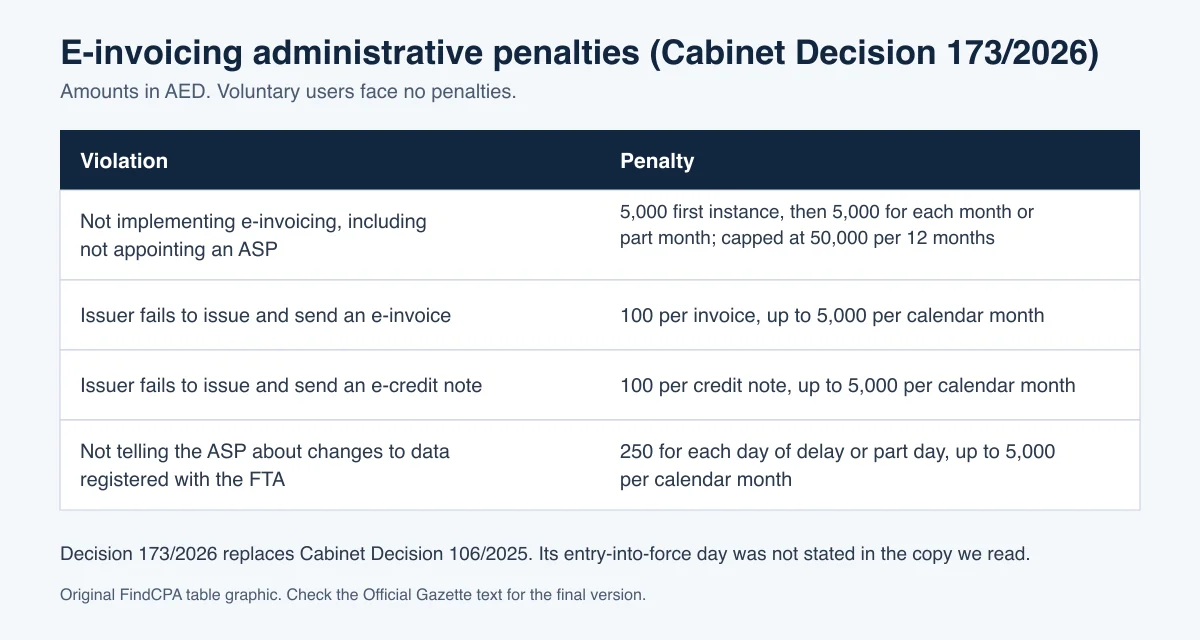
Two details help you plan. If you are both issuer and recipient for the same violation, only one penalty applies. And businesses that issue e-invoices voluntarily are excepted from these penalties.
At AED 100 per invoice, a business issuing 50 or more invoices a month reaches the monthly cap quickly. The larger risk is the implementation penalty running month after month.
Before you continue — browse 106+ verified Tax Accountant
Real reviews and up-to-date contact info
Which Businesses and Transactions Are Excluded?
Exclusions are narrow, so check yours before you assume one applies.
Ministerial Decision 197/2026, in force from 1 October 2026, excludes sovereign government activity, certain airline ticketing, VAT-exempt or zero-rated financial services, and transactions between members of the same tax group for 24 months starting 1 January 2027. Ordinary B2B sales are not excluded.
Decision 197 also sets a 14 business day window. The issuer must issue and transmit the e-invoice through the system within 14 business days of the date of the transaction.
Watch the tax group exclusion. It is a 24-month grace period for intra-group transactions only. Those group members still have to e-invoice every other transaction on their phase date. The FTA's own TIN checker states that a tax group's TIN cannot be used for e-invoicing, so each member complies with its own TIN.
Any person may also choose to e-invoice a transaction that is excluded. In that case the rules apply, apart from the penalty decisions.
How Do You Get Ready for UAE E-Invoicing?
Start with the system, not the software licence.
The MOF guidelines set four steps: understand the requirements, select and onboard with an ASP through EmaraTax, test invoice exchange end to end, then go live. You start the onboarding on EmaraTax, not the ASP. A business appoints one ASP for both sending and receiving invoices.
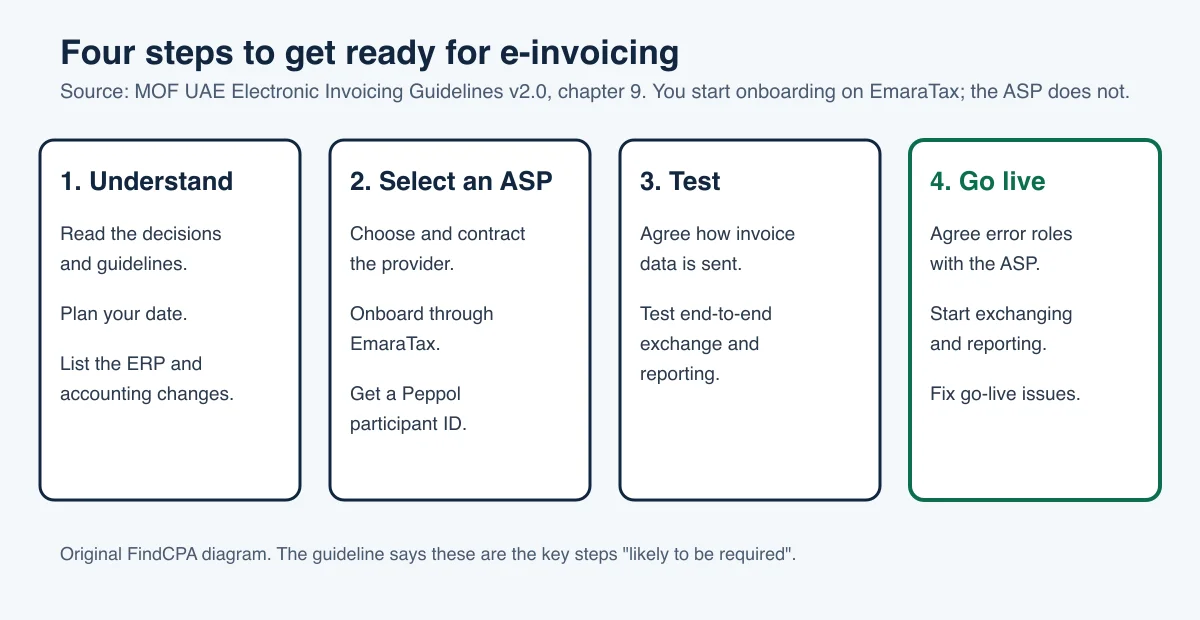
Use this checklist, adapted from the MOF readiness checklist in the guidelines:
- Confirm your FTA registration and that you have a Tax Identification Number (TIN).
- Identify the ERP, accounting and invoicing changes needed to produce the required data fields.
- Choose and contract an ASP, and agree data hosting and security terms.
- Complete onboarding with the ASP on EmaraTax.
- Get your Peppol participant identifier through the ASP.
- Agree how invoice data and confirmation messages move between your system and the ASP.
- Test sending, receiving and reporting before the go-live date.
- Agree who handles errors and rejected invoices after go-live.
Your records also need a retention plan. The guidelines require e-invoices and their associated data to be kept for the period set by the tax procedures rules, and to be producible to the FTA on request. For a taxable person that is 5 years after the tax period, with extra years if there is a dispute or audit. Our guide to VAT records and documentation covers the wider record rules.
Not sure your books are ready for structured invoices? Compare accountants and VAT advisers who can review your invoicing set-up in the FindCPA VAT consultant directory. Free to use. Call or message the firm directly.
How Do You Choose an E-Invoicing Service Provider?
An ASP is a legal gateway, so check its status before you check its price.
An Accredited Service Provider is a provider granted accreditation to supply e-invoicing services in the UAE under the e-invoicing legislation. Your ASP exchanges your invoices over Peppol and reports tax data to the FTA. The compliance obligation stays with you, not the ASP, as the MOF guidelines state.
That last point is the one that catches businesses. The guidelines say the ASP carries out the transmission, but compliance remains with the supplier. A cheap ASP that fails to deliver does not move the penalty onto the ASP.
Ask each provider these questions, and get the answers in writing:
- Accreditation: is it accredited, and can you confirm that on the official MOF and FTA e-invoicing pages?
- Your system: does it already connect to your accounting or ERP software, or will you build the integration?
- Testing: can you run end-to-end test invoices before the deadline?
- Errors: who fixes a rejected invoice, and how fast?
- Data: where is your invoice data hosted, and how do you export it if you leave?
- Fees: what is the full cost per year? The decisions we read set no ASP fee, so every price is commercial.
Do not treat your accountant as an ASP. An accounting firm may help with readiness, data mapping and testing, but only an accredited provider can transmit your invoices. Our accounting software guide explains how to check whether your current system fits.
What Should You Ask Your Accountant or Adviser?
Good advisers answer in specifics.
Ask your accountant which revenue figure places you in a phase, whether any exclusion applies, who owns the ASP integration, and how invoice data will be reconciled to VAT returns. The MOF guidelines say e-invoicing does not replace the tax invoice, so VAT filing data must still match.
Put these questions to your accountant or tax adviser:
- Which phase are we in, and which revenue figure did you use?
- Are we a tax group member, and which transactions does the 24-month grace period cover?
- Who handles credit notes, advance payments and retention invoices in the new format?
- What happens to our VAT returns when invoice data is rejected or delayed?
- Who in your firm has done an ASP onboarding on EmaraTax before?
Verify claimed experience. Ask for the type of client, the system involved and the name of the ASP. Our guides on hiring an accountant in Dubai and choosing a tax consultant cover vetting. The corporate tax adviser directory and the bookkeeping directory list firms by service.
Penalties for VAT breaches are a separate regime. See the VAT penalties matrix for those.
What Should You Do This Month?
Act on your phase, not on the headlines.
If your revenue is AED 50 million or more and you have not appointed an ASP, contact an adviser immediately, because the 30 October 2026 date has passed and go-live is 1 January 2027. Below AED 50 million, aim to choose an ASP well before the 31 March 2027 appointment date.
For the larger group, the position is urgent. Each month of non-implementation after the first instance adds AED 5,000, up to the AED 50,000 cap in any 12 months. For businesses below AED 50 million, the window is still open, so use it. The FTA notes that the system's readiness was tested in a pilot phase and that a joint meeting with providers took place in September 2026.
Our practical order of work:
- Confirm your revenue band in writing with your accountant.
- Shortlist two or three ASPs and ask the questions above.
- Open onboarding on EmaraTax.
- Run test invoices on your real data.
- Brief the staff who raise invoices, credit notes and corrections.
Read the primary sources too. The FTA announcement of 25 October 2026 is short and gives both phase dates.
Frequently Asked Questions
What is the e-invoicing deadline in the UAE?
It depends on revenue. Businesses with revenue of AED 50 million or more go live on 1 January 2027, after appointing an ASP by 30 October 2026. Businesses below AED 50 million appoint an ASP by 31 March 2027 and go live by 1 July 2027. Government entities go live on 1 October 2027.
Is e-invoicing mandatory for small businesses in the UAE?
Yes, in phase two. The MOF guidelines say all persons making business transactions in the UAE are in scope, whatever their VAT status. Businesses with revenue below AED 50 million appoint an ASP by 31 March 2027 and implement by 1 July 2027. Supplies to consumers are outside the scope.
Do I still need a VAT tax invoice if I use e-invoicing?
Yes. E-invoicing does not remove the tax invoice requirement. Under the VAT Decree-Law, a person in scope must issue its tax invoice and tax credit note as an electronic invoice and credit note. A buyer who has not yet onboarded may still ask for a separate PDF, according to the MOF guidelines.
What is the penalty for not complying with UAE e-invoicing?
Under Cabinet Decision 173/2026 the penalty is AED 5,000 for failing to implement the system, then AED 5,000 per month or part month, capped at AED 50,000 in any 12 consecutive months. Failing to issue an e-invoice costs AED 100 per invoice, up to AED 5,000 a month.
Can my accountant act as my e-invoicing service provider?
Only if the firm is itself an Accredited Service Provider. Otherwise it can support readiness, testing and VAT reconciliation, but a separate ASP must transmit your invoices. The MOF guidelines say the compliance obligation stays with you. Ask the firm to confirm its accreditation status in writing.
Keep Reading
Ready to find the right Tax Accountant?
Browse 106+ verified listings with real reviews and up-to-date contact info.
Start Your SearchFindCPA
The FindCPA team, providing trusted content about Accountants & CPAs.