UAE VAT Explained: Rates, Registration and Returns
Need a Auditor? Browse verified listings
Browse NowUAE VAT is a 5% tax with strict deadlines.
Most businesses learn the rules after the first penalty notice. This guide gives you the whole picture first: the rate, who must register, how returns work, what records to keep and where each topic goes deeper.
It is written for English-speaking business owners, finance managers and individuals, including Americans, who meet VAT for the first time in the UAE. Every rule below points to the Federal Tax Authority (FTA), the UAE Government portal or the executive regulation, and we read those sources on 25 November 2026.
What Is UAE VAT and How Does It Work?
Think of VAT as a relay.
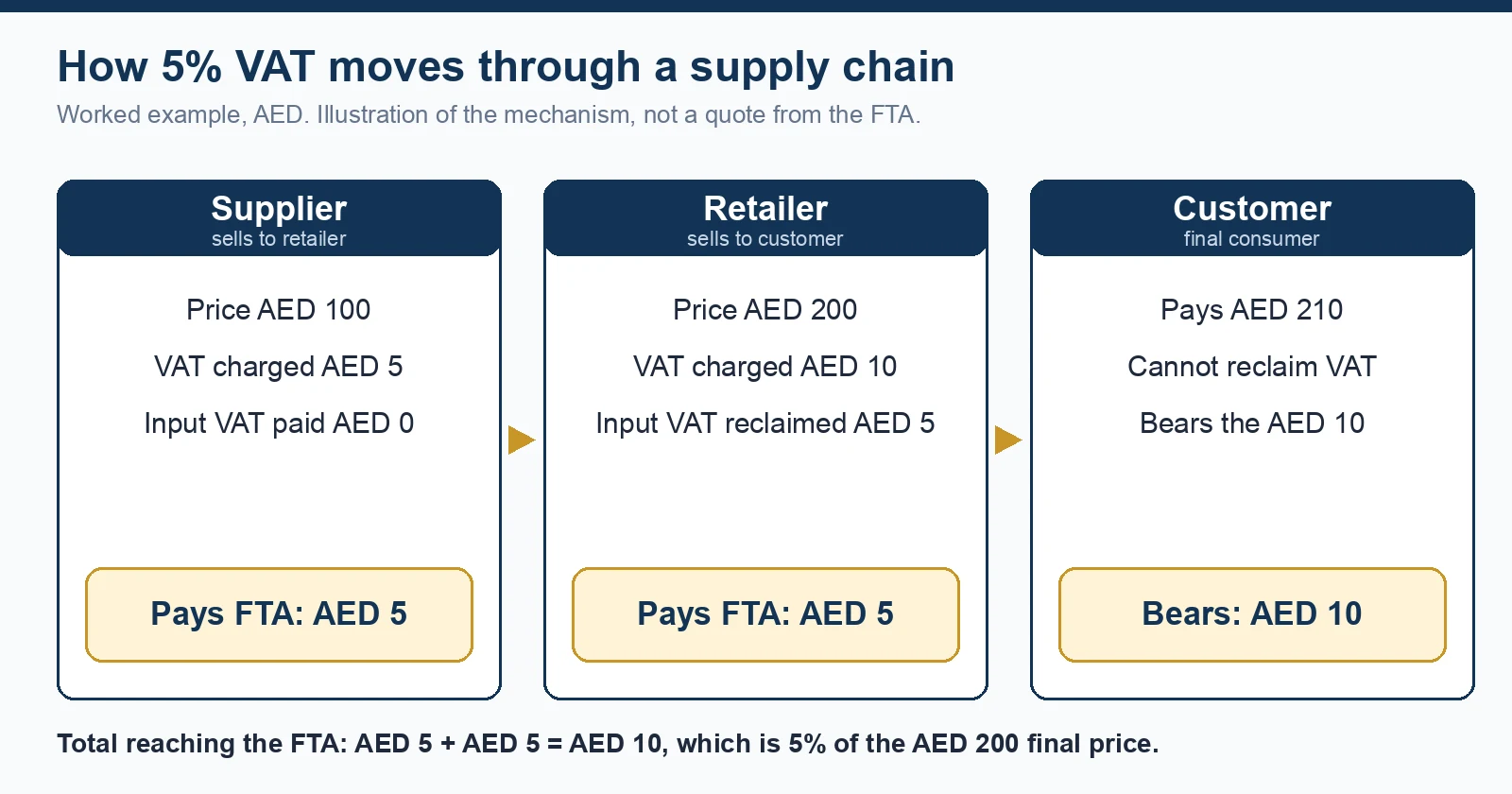
UAE VAT is a 5% consumption tax on most goods and services, collected by registered businesses on behalf of the Federal Tax Authority under Federal Decree-Law No. 8 of 2017. The UAE Government portal confirms the 5% rate. Each business charges VAT on sales, reclaims it on costs and pays only the difference.
The UAE Government taxation page states that the UAE levies 5% value added tax on the purchase of goods and services. The tax started on 1 January 2018.
The FTA describes VAT as a transaction-based indirect tax levied at each step of the supply chain. End consumers bear the cost, while registered businesses act as tax collectors. The FTA's "What is VAT?" page adds that VAT is used in more than 180 countries.
Look at the diagram above. A supplier sells to a retailer for AED 100 plus AED 5 VAT. The retailer sells to a customer for AED 200 plus AED 10 VAT. The retailer reclaims the AED 5 it paid and sends the FTA the other AED 5.
The customer carries the full AED 10. That is the whole mechanism, and it explains most of the rules that follow.
How Is VAT Different From US Sales Tax?
Americans ask this first.
US sales tax is charged once, at the final retail sale. UAE VAT is charged and reclaimed at every business stage. The FTA notes that all OECD countries except the United States have a VAT or a variation of it, so a US-trained finance team needs to learn the input and output logic from scratch.
The FTA says it directly: all OECD countries except the US have VAT or a variation of it, and to the end consumer it feels like a general sales tax. The difference is behind the till.
A US merchant collects sales tax and remits it. A UAE business does the same on sales, but it also deducts the VAT it paid on purchases. That deduction is called input tax, and it is why VAT records matter so much.
The second difference is scope. VAT in the UAE applies to services as well as goods. Professional fees, software subscriptions and many B2B services carry VAT unless a specific rule zero-rates or exempts them.
For a longer comparison written for US readers, see our guide to VAT in Dubai.
Which Supplies Are Standard-Rated, Zero-Rated or Exempt?
Treatment decides everything.
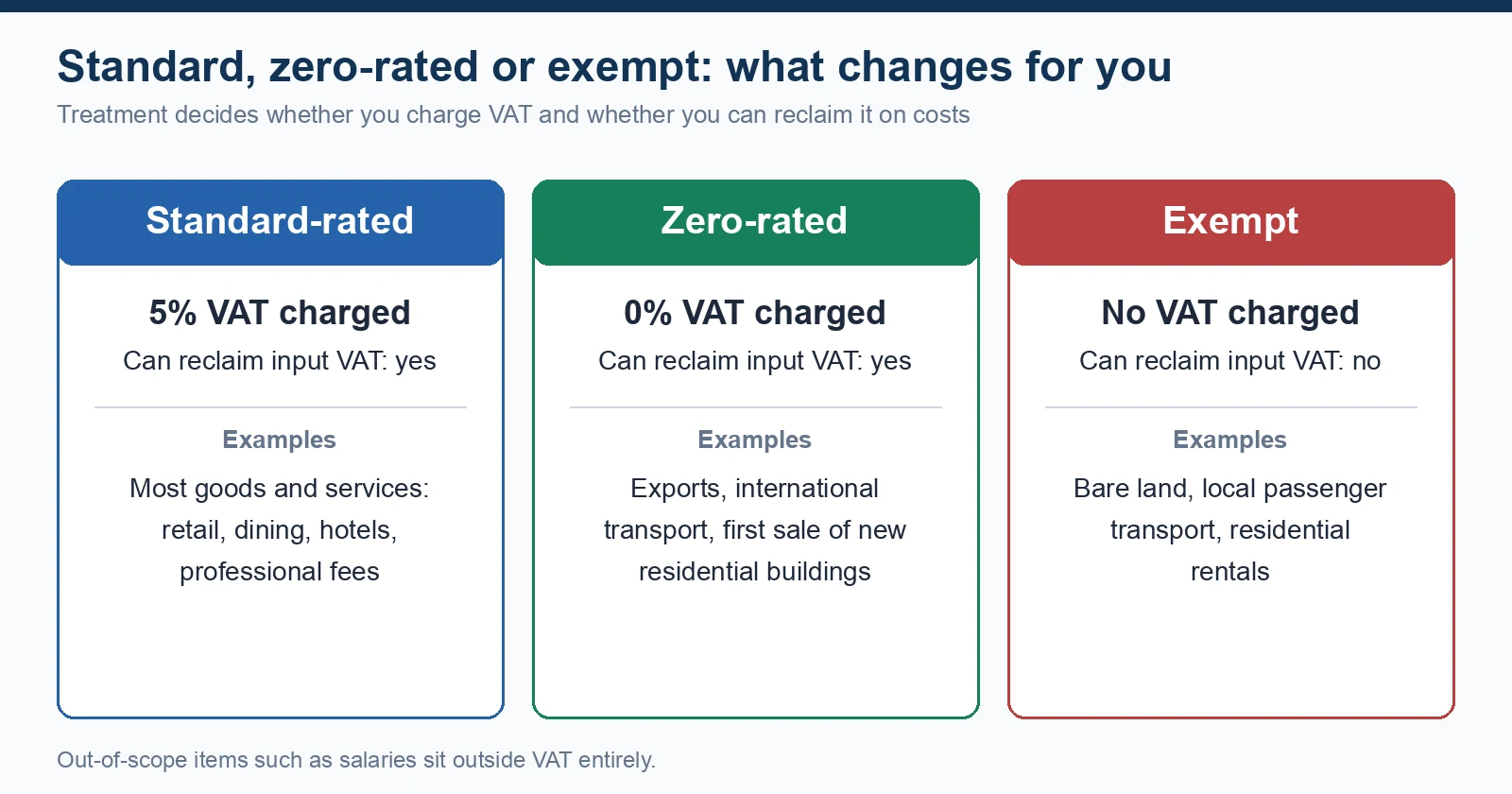
Every supply in the UAE falls into one of four buckets: standard-rated at 5%, zero-rated at 0%, exempt, or outside the scope of VAT. Cabinet Decision No. 52 of 2017 lists the zero-rated and exempt cases, including exports, international transport, bare land and local passenger transport.
The difference between zero-rated and exempt is the part people get wrong. A zero-rated supply is still a taxable supply, so you can reclaim input VAT on the costs behind it. An exempt supply is not taxable, so that input VAT is a cost you absorb.
| Treatment | VAT charged | Reclaim input VAT? | Examples in the executive regulation |
|---|---|---|---|
| Standard-rated | 5% | Yes | Most goods and services |
| Zero-rated | 0% | Yes | Export of goods and qualifying services, international transport, investment precious metals |
| Exempt | None | No | Residential buildings, bare land, local passenger transport |
| Out of scope | None | Not applicable | Items outside the VAT law, such as salaries |
Source: Cabinet Decision No. 52 of 2017 and amendments, Articles 30 to 45, as published by the FTA. Not an official translation.
Healthcare and education also have their own rules. Qualifying services in those sectors can be zero-rated, which we cover in VAT on healthcare and education in the UAE.
Real estate has its own split between residential, commercial and first supplies. Read VAT on real estate in the UAE before you price a property deal.
Before you continue — browse 55+ verified Auditor
Real reviews and up-to-date contact info
Who Must Register for UAE VAT and When?
Registration depends on your numbers.
A UAE business must register for VAT when its taxable supplies and imports exceed AED 375,000 over the previous 12 months, or when it expects to exceed that figure within the next 30 days. The FTA allows voluntary registration above AED 187,500, counting taxable expenses as well as sales.
The FTA's registration page, last updated on 6 April 2026, sets out both tests. The mandatory threshold does not apply to foreign businesses.
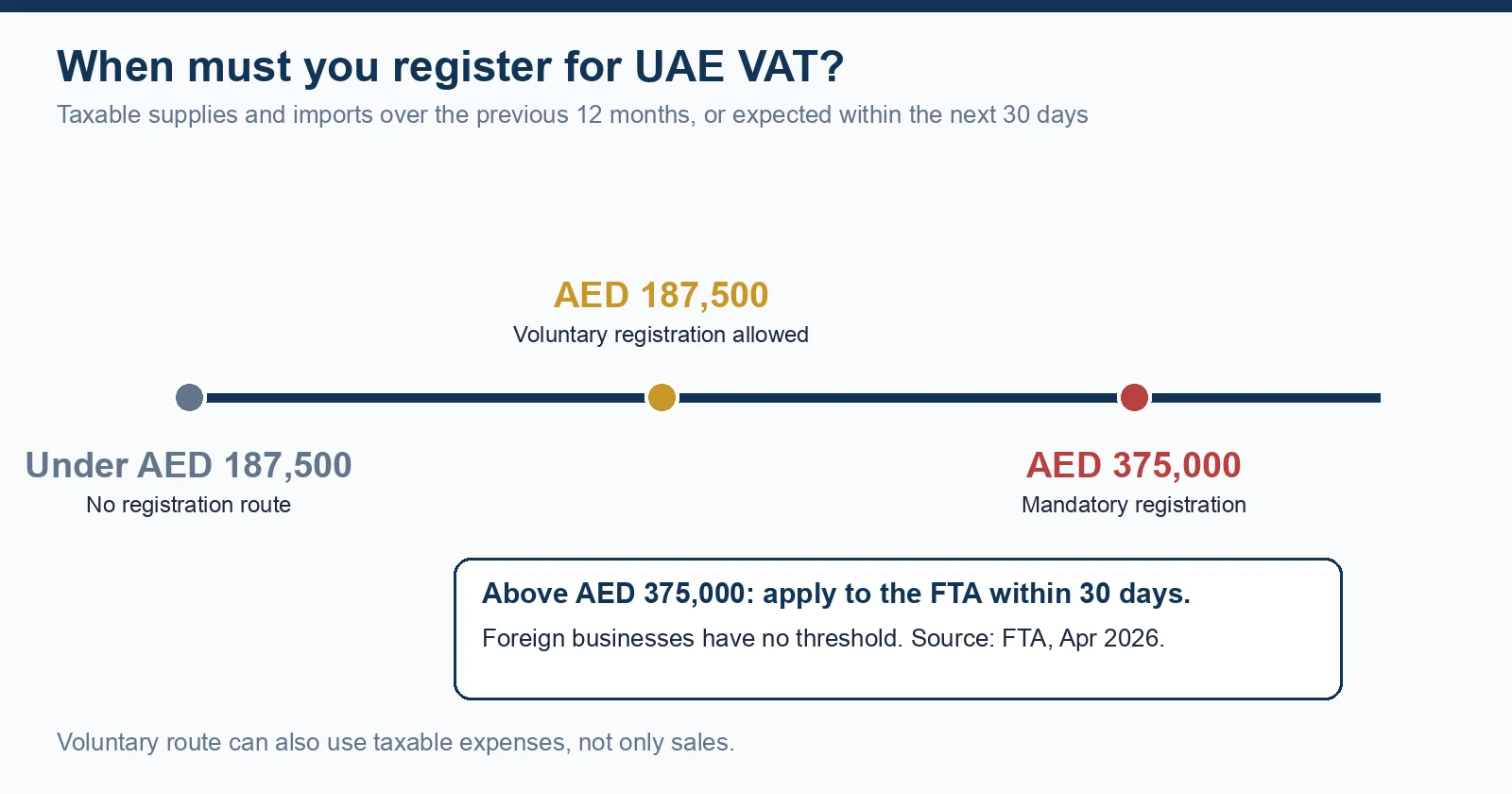
Two practical points save money. Count the rolling 12 months, not the financial year. And register before you cross the line if a large contract is about to land.
Start-ups often miss the voluntary route. A new company that buys equipment and stock before it sells can reclaim input VAT once registered. The detail sits in VAT registration requirements in the UAE and the step-by-step VAT registration guide.
Two more guides narrow the question. VAT registration threshold in the UAE explains how to count supplies, and VAT registration threshold changes tracks updates to the figures.
Does this sound like your business? Not sure whether you have crossed AED 375,000 or whether a voluntary registration pays off? Browse VAT consultants in the UAE and compare listed firms. Two minutes to browse. Free. No sign-up.
How Do You File a UAE VAT Return and Pay the Tax?
Returns run on a fixed clock.
Once registered, a UAE business must file its VAT return and pay the tax within 28 days of the end of its tax period. The executive regulation sets the standard tax period at three calendar months. A period ending on 31 December therefore has a return due by 28 January.
The FTA's filing page says registered businesses must file and pay within 28 days from the end of the tax period. Article 64 of the executive regulation says the FTA must receive the return by the 28th day after the period ends, or another date the FTA directs.
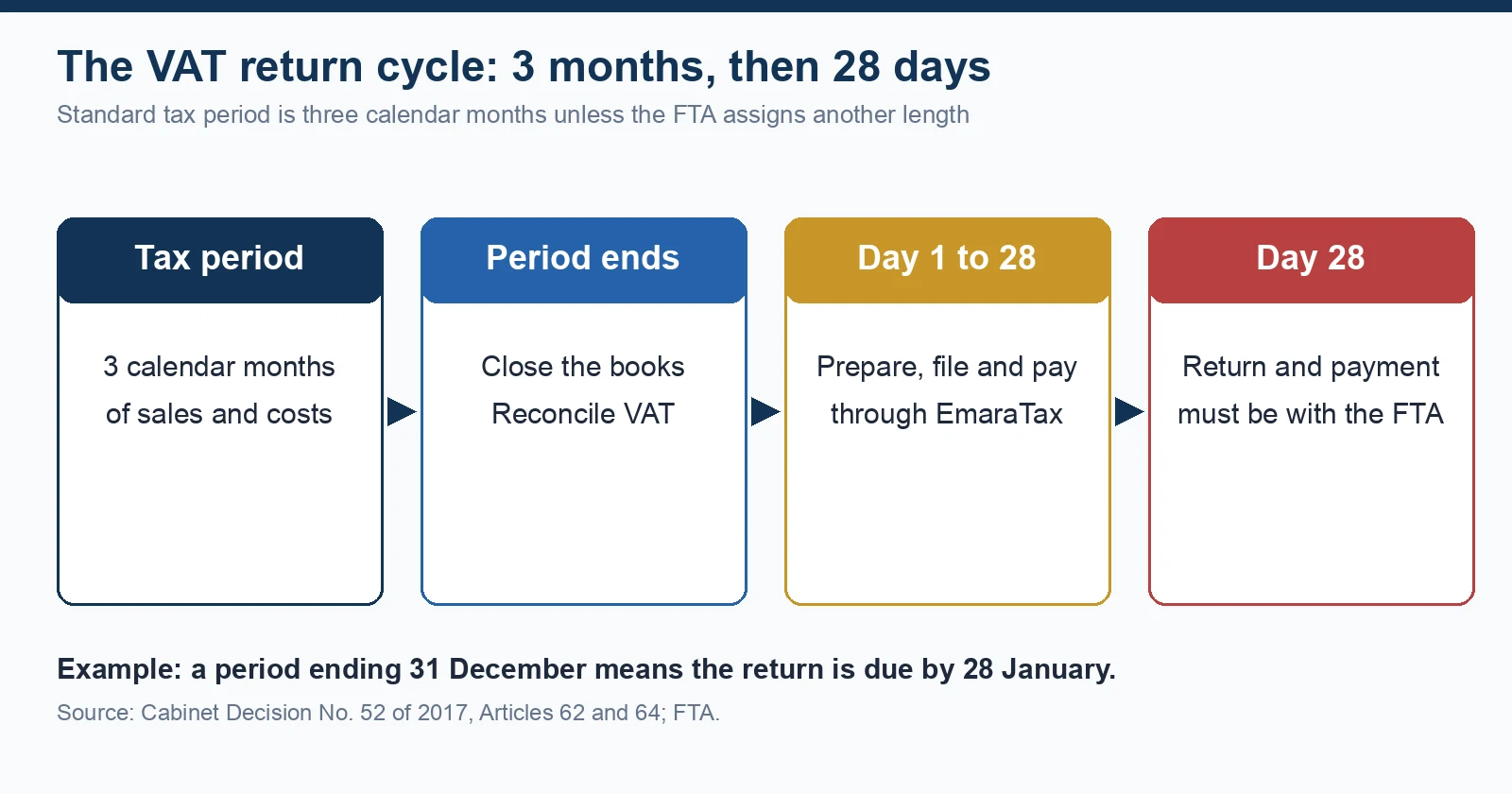
Article 62 allows the FTA to assign shorter or longer periods. Your EmaraTax account shows the period assigned to you, so check it before you plan your close.
A return reports VAT on sales and other outputs, VAT on purchases and other inputs, and the net amount due. If your output VAT is higher than your input VAT, you pay the difference. If input VAT is higher, you can claim a refund.
The full walk-through is in our VAT return filing guide. If you want the submission screen by screen, use UAE VAT submission.
What VAT Records Must You Keep?
Records protect your refunds.
A UAE VAT-registered business must keep tax invoices, credit notes and supporting documents for every return it files, because the FTA can deny input tax that you cannot prove. The records must be in a form the FTA can inspect, and the retention period runs for years, not months.
Without a valid tax invoice, you cannot reclaim the VAT you paid. That one rule drives most disputes at audit.
The FTA also expects evidence for zero-rated sales. Export documents, transport records and contracts all count. Our guide to VAT records and documentation in the UAE lists the documents by transaction type.
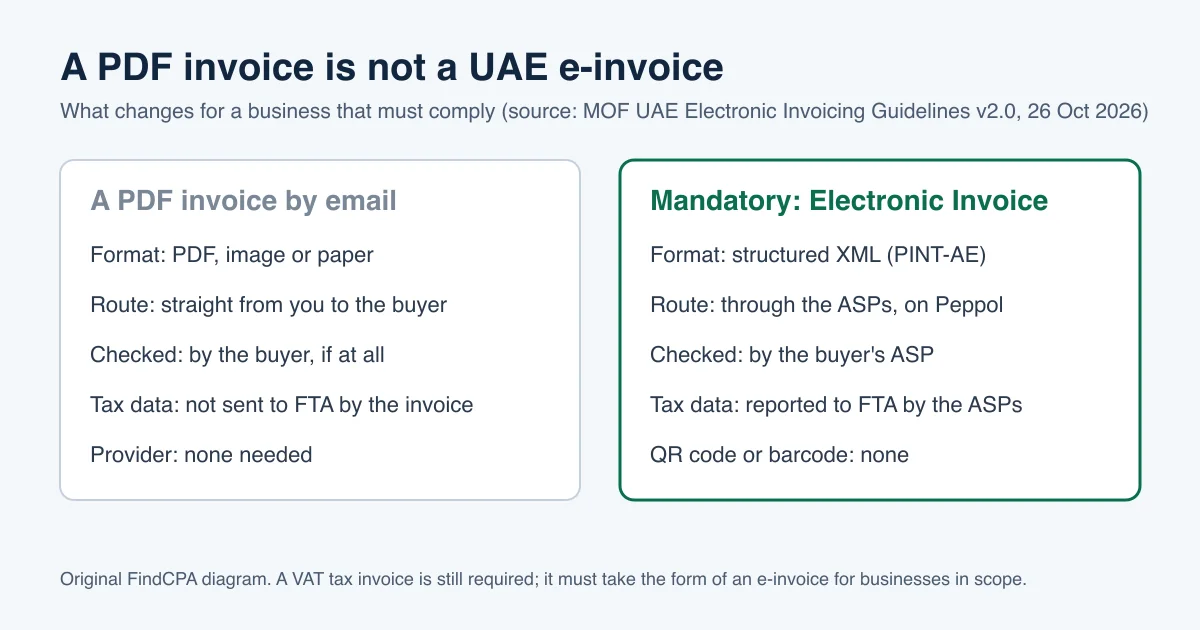
The FTA is also phasing in electronic invoicing. Its own site lists a dedicated e-invoicing section and warns businesses to meet the prescribed legal deadlines to avoid administrative penalties. Check your accounting software supports it, using our accounting software guide.
What Happens If You Get VAT Wrong?
Penalties arrive automatically.
The FTA issues fixed administrative penalties for late registration, late filing and incorrect returns, and a percentage penalty on unpaid tax. The amounts come from Cabinet Decision No. 49 of 2021 and its amendments, so read the current schedule before you quote a figure.
We do not repeat a number here because the schedule has been amended and secondary sources disagree. Our VAT penalties matrix lays out each violation type, and the FTA's current legislation page is the source to confirm it.
Most penalty exposure comes from five avoidable errors:
- Registering late after crossing the threshold.
- Filing after day 28 of the period.
- Paying less than the return shows.
- Claiming input VAT without a valid tax invoice.
- Zero-rating a sale without export evidence on file.
If you spot a mistake in a filed return, fix it before the FTA does. VAT voluntary disclosure explains how. Then read common VAT mistakes in the UAE to stop repeating them.
If the FTA announces an audit, our FTA VAT audit preparation guide shows what to assemble first.
Which VAT Topic Should You Read Next?
Your situation decides the next page.
FindCPA publishes more than 25 UAE VAT guides covering registration, returns, free zones, property, e-commerce, imports and exports, grouping, refunds and audits. The table below maps each common question to the guide that answers it, so you can go straight to your situation.
We built this page as the entry point to those guides. All of them follow the same sources and the same executive regulation.
| If your question is about | Read |
|---|---|
| Input and output VAT | Input VAT vs output VAT |
| Buying services from abroad | Reverse charge mechanism |
| Free zone companies | VAT on free zone transactions and designated zones |
| Several companies under one owner | VAT grouping |
| Online stores | VAT for e-commerce |
| Software and digital services | VAT on digital services |
| Cross-border goods | VAT on imports and exports |
| Restaurants and hotels | VAT for restaurants and hospitality |
| Used goods | Profit margin scheme |
| Visitors leaving the UAE | Tourist VAT refund |
| Closing a VAT account | VAT deregistration |
| Working with an adviser | VAT tax agent registration |
| Staying compliant all year | VAT compliance tips |
| Reclaiming input VAT in Dubai | VAT tax refund in Dubai |
Excise tax is separate from VAT. If you sell tobacco, energy drinks or similar goods, start with excise tax in the UAE.
The rules change. The executive regulation file the FTA publishes lists its latest amendment as Cabinet Decision No. 149 of 2026, effective 1 October 2026. When a rule matters to a decision, read the current consolidated text rather than an old summary.
How Do You Choose a VAT Adviser or Auditor?
Pick the specialist, not the cheapest quote.
Choose a VAT adviser who can show FTA registration as a tax agent, UAE sector experience and a clear scope in writing. The FTA runs a UAE Tax Agent Programme and publishes a list of registered tax agents, so you can verify any firm before you sign an engagement letter.
Ask four questions before you hire. Does the firm file returns in EmaraTax every quarter? Has it handled an FTA audit in your sector? Who reviews the work? What happens if the FTA issues a penalty?
A bookkeeper can prepare a return. A VAT consultant should also challenge your treatment of each supply, and an auditor checks your statements against the accounts. Know which one you need.
FindCPA lists accountants, auditors and VAT advisers across Dubai, Abu Dhabi, Sharjah and Ajman. Browse VAT consultants or the wider auditor directory. FindCPA is free to use and does not sell any filing service.
Frequently Asked Questions
What is the VAT rate in the UAE?
The UAE VAT rate is 5% on most goods and services. The UAE Government portal confirms the rate, and it has applied since 1 January 2018. Some supplies are zero-rated, such as exports and international transport, and some are exempt, such as bare land and local passenger transport.
What is the VAT registration threshold in the UAE?
The mandatory VAT registration threshold is AED 375,000 in taxable supplies and imports over the previous 12 months. Voluntary registration is allowed above AED 187,500, including taxable expenses. The FTA states the mandatory threshold does not apply to foreign businesses.
How often do you file a UAE VAT return?
The standard tax period is three calendar months, so most businesses file quarterly. You must file and pay within 28 days of the period end. The FTA can assign a shorter or longer period, so check your EmaraTax account for the one assigned to you.
Do I need an accountant for UAE VAT?
The law does not force you to hire one, but the rules are strict. A qualified accountant or registered tax agent helps you classify supplies, file by the 28-day deadline and keep valid tax invoices. Use FindCPA to compare listed firms before you decide.
Keep Reading
Ready to find the right Auditor?
Browse 55+ verified listings with real reviews and up-to-date contact info.
Start Your SearchFindCPA
The FindCPA team, providing trusted content about Accountants & CPAs.