Dubai Tax Explained: What You Pay in 2026
Need a Auditor? Browse verified listings
Browse NowDubai tax is simpler than most people expect.
It is also stricter than most people assume. The city charges no income tax on salaries, yet a business here can owe VAT, corporate tax and excise tax, each with its own registration and filing rules.
This overview shows what you pay, who pays it and where the rules come from. It is written for English-speaking readers, including Americans, who are deciding whether to move, open a company or hire an accountant in Dubai. Every tax claim below points to the UAE Government portal, the Ministry of Finance or the Federal Tax Authority (FTA), and we read those pages on 15 November 2026.
What Is Dubai Tax and What Do You Actually Pay?
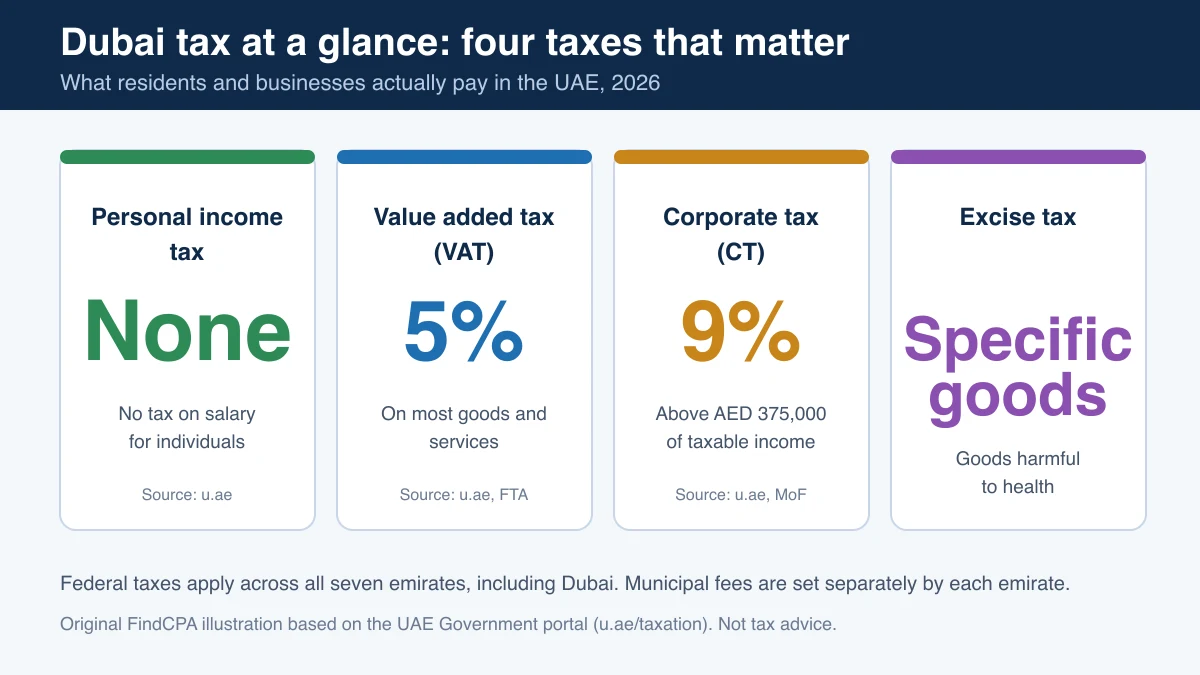
Dubai tax is the set of federal taxes that apply in the emirate of Dubai under UAE law: 5% value added tax, corporate tax of 9% on taxable income above AED 375,000, and excise tax on specific goods. The UAE Government portal confirms there is no income tax on individuals. Dubai does not run a separate income tax of its own.
Dubai tax is not a Dubai-only system. Tax law in the UAE is federal, so the same VAT and corporate tax rules apply in Dubai, Abu Dhabi, Sharjah and every other emirate. The UAE Government taxation page lists the four pieces in one sentence: no personal income tax, 5% VAT on goods and services, excise tax on goods harmful to health, and corporate tax on the net income of businesses.
Emirates add their own fees on top. Dubai charges a housing fee through utility bills and a tourism dirham on hotel stays, for example. Those are municipal charges, not federal taxes, so we cover them separately below.
Here is the quick map.
| Tax | Rate | Who it hits | Official source |
|---|---|---|---|
| Personal income tax | None | Individuals earning a salary | u.ae |
| Value added tax (VAT) | 5% | Most goods and services; businesses collect it | u.ae and FTA |
| Corporate tax | 0% up to AED 375,000, 9% above | Companies and some individuals running a business | u.ae |
| Excise tax | Varies by product | Specific goods harmful to health | u.ae |
The dirham is pegged to the US dollar at roughly AED 3.67 per USD, so AED 375,000 is close to USD 102,000. That conversion helps American readers size the thresholds. Always file in dirhams.
Does Dubai Have a Personal Income Tax?
No. That is the headline fact, and it is true.
No. The UAE Government portal states that the UAE does not levy income tax on individuals. A salaried employee in Dubai keeps the full gross salary with no federal income tax withheld. The same employee still pays 5% VAT on most purchases and may pay municipal fees on rent and hotel stays.
This is why Dubai attracts so many expats. A salary of AED 30,000 a month arrives as AED 30,000 a month, before any cost-of-living effects.
Three limits stop this from becoming a free pass.
- Business income is different. An individual who runs a business can fall inside corporate tax once turnover passes AED 1 million in a calendar year. We cover that rule in its own section.
- Home-country tax still applies. Americans owe US tax on worldwide income. Other countries have their own residency tests.
- Spending is taxed. VAT at 5% sits on rent for commercial property, restaurant meals, electronics and most services.
Our personal income tax guide for the UAE walks through the residency and employment-income rules in more detail.
How Does VAT Work in Dubai?
VAT is the tax most residents meet first.
UAE VAT is a 5% consumption tax charged on most goods and services, introduced in 2018 under Federal Decree-Law No. 8 of 2017. Businesses with taxable supplies above AED 375,000 a year must register with the FTA, collect VAT from customers and file returns. Voluntary registration starts at AED 187,500.
The Federal Tax Authority's VAT registration page states that a business must register once its taxable supplies and imports exceed AED 375,000, and may register voluntarily above AED 187,500. The VAT law is Federal Decree-Law No. 8 of 2017, and the FTA's published Executive Regulation shows it took effect on 1 January 2018. Our VAT registration threshold guide explains the rolling 12-month test and the 30-day rule that catch growing businesses out.
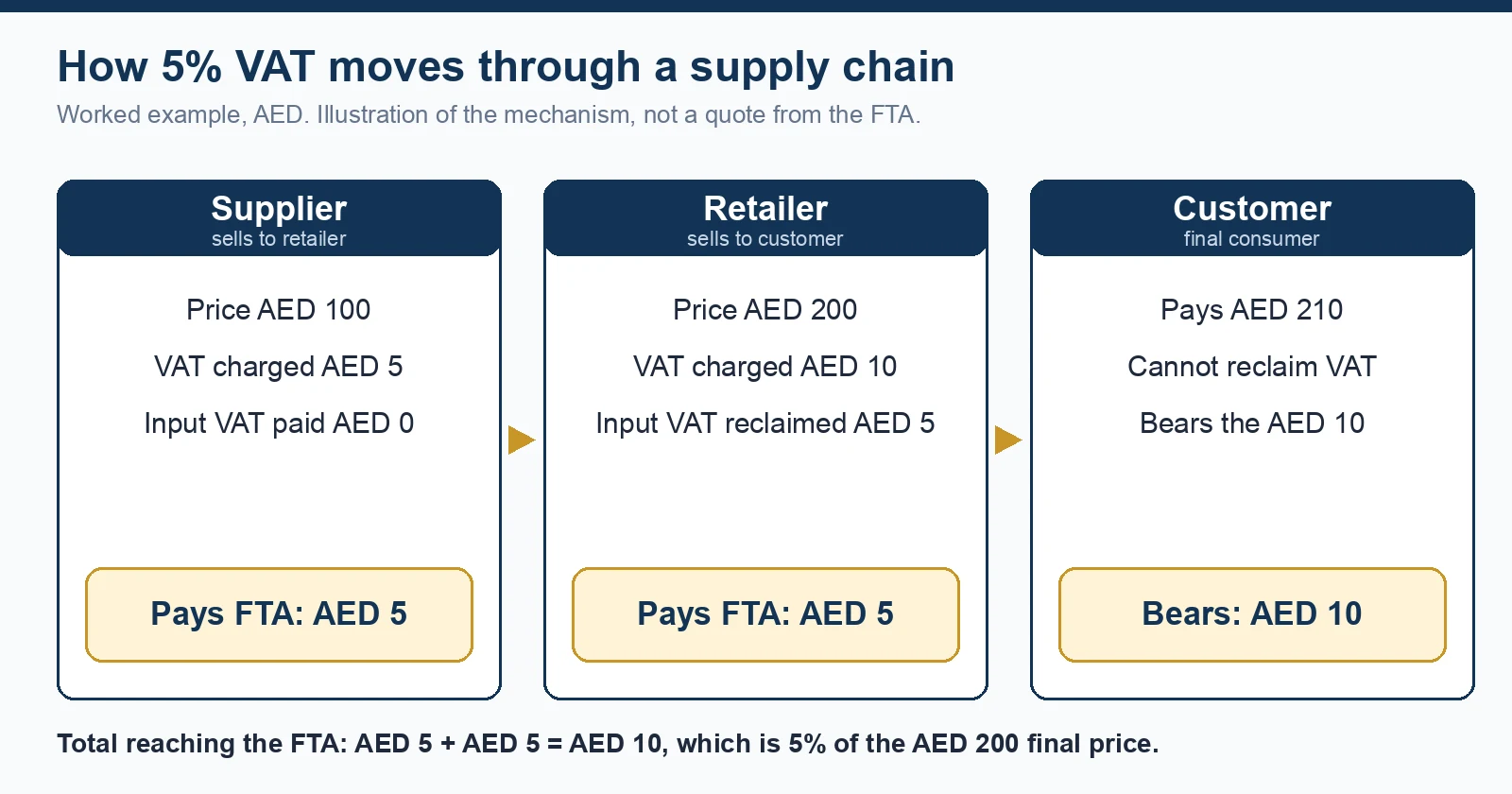
Here is how the 5% works in practice.
- A customer buys a laptop for AED 1,000 before tax.
- The shop charges AED 50 VAT and collects AED 1,050.
- The shop keeps the AED 50 only until it files its return, then pays it to the FTA after subtracting the VAT it paid on its own purchases.
That subtraction is called input VAT recovery, and it is the reason a small business with a lot of purchases often registers early. Our guide to input VAT and output VAT shows the full calculation.
Deadlines are not flexible. The FTA homepage announcements list 30 November 2026 as the final deadline for filing VAT returns, as read on 15 November 2026. Missing a filing date triggers an administrative penalty, so many small businesses hand the calendar to a tax agent.
For a Dubai-specific, step-by-step version, read VAT in Dubai: what it costs and who must register and the full VAT registration walkthrough. Tourists can also reclaim VAT on most purchases at the airport, which we cover in our Dubai VAT refund guide.
Before you continue — browse 55+ verified Auditor
Real reviews and up-to-date contact info
How Does Corporate Tax Work in Dubai?
Corporate tax is the biggest change in UAE tax history.
UAE corporate tax is a federal tax on business profits under Federal Decree-Law No. 47 of 2022. The rate is 0% on taxable income up to AED 375,000 and 9% above that. Businesses became subject to it from the start of their first financial year beginning on or after 1 June 2023, according to the UAE Government portal.
The UAE Government corporate tax page says the tax applies to businesses and individuals conducting business under a commercial licence, to free zone businesses, and to foreign entities and individuals that run a trade or business in the UAE on an ongoing basis. Banking operations and businesses in real estate management, construction, development, agency and brokerage are also in scope.
A company with a December year-end therefore started its first taxable year on 1 January 2024. A company with a June year-end started on 1 July 2023.
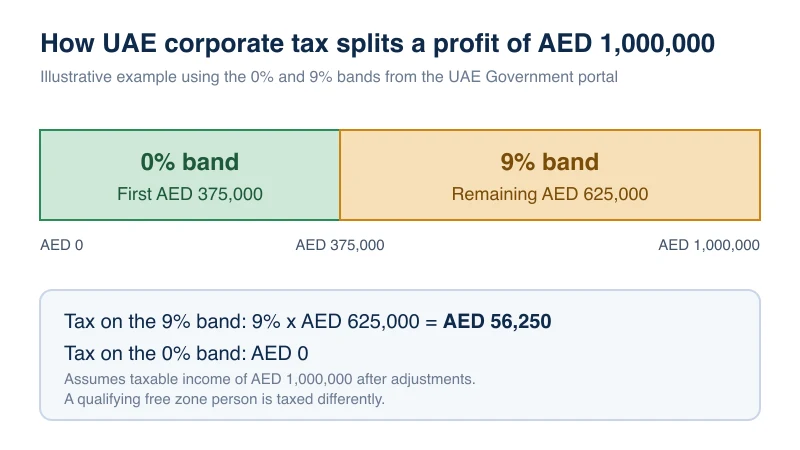
Take a company with AED 1,000,000 of taxable income. The first AED 375,000 is taxed at 0%. The remaining AED 625,000 is taxed at 9%, which gives AED 56,250 of corporate tax. That is the simple version. Real taxable income starts from accounting profit and then moves through adjustments, which is where an accountant earns the fee.
Some businesses fall outside the charge. The government portal lists automatically exempt entities, such as government entities, and others that qualify after notifying the Ministry of Finance or applying to the FTA, such as pension funds and qualifying investment funds. Free zone companies that meet the conditions of a qualifying free zone person pay 0% on qualifying income. Our guide to free zone qualifying income breaks down those conditions.
Very large multinational groups face a separate regime. The FTA has issued a guide on the scope and registration for Top-up Tax on multinational enterprises, and it does not affect a typical SME.
The FTA's own worked examples also show a relief for smaller businesses, using revenue of AED 3,000,000 as the cut-off in the prior tax period. Our small business relief guide explains who can use it and when it ends.
For the full rulebook, including registration, return filing and penalties, go to our UAE corporate tax guide.
Does this sound like your business? Wondering whether you owe 0%, 9% or nothing at all? Browse corporate tax advisers in the UAE and compare listed firms. Two minutes to browse. Free. No sign-up.
Do Freelancers and Individuals Pay Corporate Tax in Dubai?
Sometimes. This one catches people out.
Yes, when an individual runs a business. Under the UAE corporate tax rules, a natural person such as a freelancer or sole establishment owner becomes taxable once business turnover exceeds AED 1 million in a calendar year. Salary, personal investment income and most personal property income stay outside the scope of corporate tax.
The Government portal states that corporate tax covers individuals who conduct business under a commercial licence. The FTA's natural person basis of taxation page sets the trigger: total turnover from a business or business activities above AED 1 million within the calendar year. We explain it in our natural person corporate tax guide.
| Situation | Corporate tax? |
|---|---|
| Employee earning a salary | No |
| Freelancer with AED 600,000 of turnover | Not yet, under the AED 1 million trigger |
| Sole owner with AED 1.4 million of turnover | Yes, as a natural person |
| Company with AED 300,000 of taxable income | Taxed at 0% on the first AED 375,000 |
| Company with AED 900,000 of taxable income | 9% on AED 525,000, which is AED 47,250 |
The table is an illustration of how the rates stack, not a ruling on any real case. Turnover and taxable income are different measures, and the FTA looks at both. Read our freelancer corporate tax guide before you assume you are safe.
What Other Taxes and Fees Apply in Dubai?
Federal tax is only half the bill.
Beyond VAT and corporate tax, Dubai residents meet excise tax on specific goods, municipal charges and tourism fees. Dubai Municipality's housing fee is collected through the DEWA utility bill, according to DEWA. Hotel guests pay the Tourism Dirham Fee, which Dubai's tourism authority sets by administrative resolution.
Excise tax applies to specific goods that the government treats as harmful to health, according to the UAE Government portal. It is charged on top of VAT, so a product can carry both. Our excise tax guide lists the product categories.
The municipal items are set by each emirate, not by the federal government. DEWA's VAT page says it collects the housing fee on behalf of Dubai Municipality and that VAT does not apply to that fee. The Tourism Dirham resolution sets the rules for calculating, collecting and paying the hotel fee. We do not quote the rates here because they sit with the municipality and the tourism authority and can change. Our municipal fees and tourism taxes guide gives indicative figures.
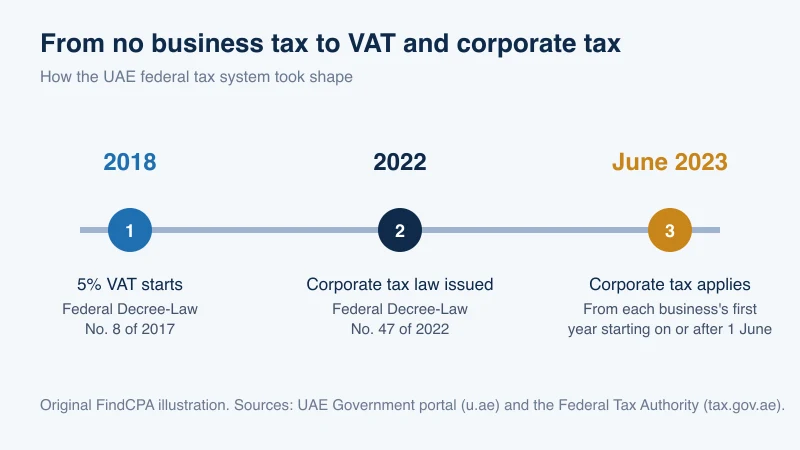
The timeline above shows why so many long-time residents feel the system changed overnight. VAT arrived in 2018. Corporate tax followed five years later. Between those dates the UAE built the registration platform, EmaraTax, which now handles most FTA filings.
Do US Citizens in Dubai Still Owe US Tax?
Yes. Moving to Dubai does not end US filing.
Yes. The IRS states that US citizens and resident aliens are subject to tax on worldwide income and must report all taxable income, whether they live in the United States or abroad. Americans living overseas get an automatic two-month extension, moving the usual 15 April due date to 15 June. Interest still runs on unpaid tax.
The two-month extension comes from IRS Topic 304, which gives US citizens and resident aliens who are out of the country two extra months, generally until 15 June, and says interest still runs on tax not paid by the unextended due date. The IRS guidance for citizens and resident aliens abroad also says many Americans abroad qualify for the foreign earned income exclusion and the foreign tax credit, but only by filing a US return. It adds that taxpayers with foreign financial accounts above the reporting threshold must file an FBAR with FinCEN, usually by 15 April.
Dubai's zero income tax therefore means something different for an American. It lowers the foreign tax you can credit, so your US filing may be your only income tax return. Our guide to Dubai taxes for US citizens covers the forms, and our expat US tax guide covers the next steps.
An American who owns a Dubai company faces both systems at once. UAE corporate tax applies to the company, and US reporting applies to the owner. That is the moment a cross-border accountant pays for itself.
Which Dubai Tax Applies to You?
Start with who you are.
Your Dubai tax position depends on four facts: whether you earn a salary or run a business, whether your supplies pass AED 375,000, whether your taxable income passes AED 375,000, and whether you hold a US passport or another citizenship-based tax status. An employee pays 5% VAT on spending only. A business can face VAT and corporate tax together.
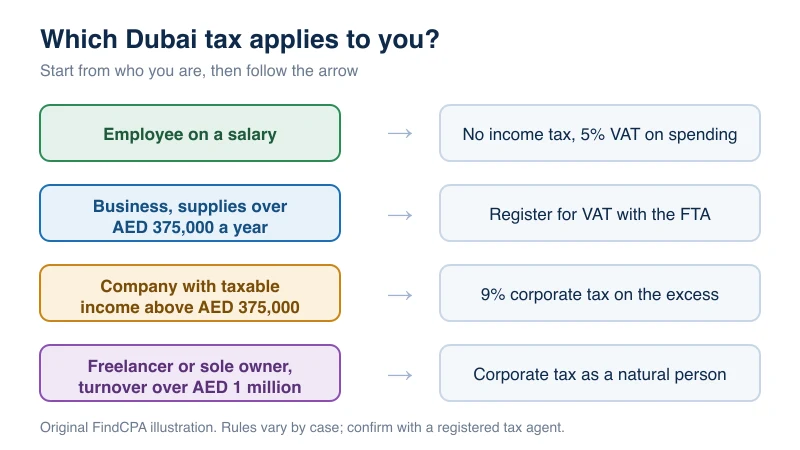
Use this checklist to find your starting point.
- Employee on a salary. No UAE income tax. You pay VAT on spending. Check home-country filing duties.
- Business with supplies above AED 375,000. Register for VAT with the FTA through EmaraTax and file returns.
- Company with taxable income above AED 375,000. Register for corporate tax and file an annual return. Corporate tax returns are due within nine months of the end of the tax period, per the FTA's September 2025 reminder. Our corporate tax return filing guide shows the steps.
- Freelancer or sole owner above AED 1 million of turnover. Register as a natural person for corporate tax.
- US citizen. File IRS returns as well, whatever UAE rules say.
Free zone companies need an extra check. A company in a free zone can still owe VAT, and its corporate tax result depends on whether it meets the qualifying free zone person conditions. Our guide to free zone and mainland tax differences lays out both.
How Do You Stay Compliant and Find the Right Accountant?
Keep it simple, and keep the records.
Stay compliant by registering on the FTA's EmaraTax platform, keeping invoices and accounts for audit, filing every return by its deadline and using a registered tax agent when your case is complex. The FTA runs a UAE Tax Agent Programme and publishes a register of registered tax agents, so you can verify a professional before you hire one.
The FTA site also states that its services are available only through UAE Pass, so set that up before you start a registration. After that, the routine is short.
- Register for the taxes you owe, using EmaraTax.
- Keep sales invoices, purchase invoices and bank records in an organised file.
- Calendar your filing dates, and file before the last day.
- Review your position each year, because thresholds and exemptions change what you owe.
Our guide to choosing a tax consultant lists the questions to ask about registration, experience and fees. If you are comparing firms, FindCPA lists 275 accounting and tax firms across Dubai, Abu Dhabi, Sharjah and Ajman, as of 6 November 2026. Use the tax accountant directory for general help, the VAT consultant directory for VAT work and the corporate tax directory for corporate tax.
One honest limit: a directory listing is not an endorsement. FindCPA does not set or verify firm fees, so confirm scope and price in writing and check any tax agent against the FTA register before you pay.
This article is general information, not tax advice. Rates and rules change, and your facts decide your result. Confirm details with the FTA or a registered tax agent.
Frequently Asked Questions
How much tax do you pay in Dubai?
An individual employee pays no income tax in Dubai, only 5% VAT on most purchases. A business pays 5% VAT on taxable supplies once registered and 9% corporate tax on taxable income above AED 375,000. The first AED 375,000 of taxable income is taxed at 0%, per the UAE Government portal.
Is there really no income tax in Dubai?
Correct. The UAE Government portal states that the UAE does not levy income tax on individuals. Salaries are paid gross. The exceptions are business income above AED 1 million turnover, which can bring a freelancer into corporate tax, and home-country taxes such as US taxation of citizens on worldwide income.
What is the VAT rate in Dubai?
The VAT rate in Dubai is 5%, the same across the UAE. Businesses must register with the Federal Tax Authority once taxable supplies pass AED 375,000 a year, and voluntary registration starts at AED 187,500. VAT was introduced in 2018 under Federal Decree-Law No. 8 of 2017.
Do I need an accountant for Dubai tax?
Not by law for every person, but most businesses benefit from one. VAT returns, corporate tax returns and free zone qualifying income tests carry deadlines and penalties. A registered tax agent can file on your behalf, and the FTA publishes a register so you can verify the firm.
Keep Reading
Ready to find the right Auditor?
Browse 55+ verified listings with real reviews and up-to-date contact info.
Start Your SearchFindCPA
The FindCPA team, providing trusted content about Accountants & CPAs.